
Home / Blog
AI SEO is the process of improving your online presence so your business can be discovered through both traditional search results and AI-powered search experiences.
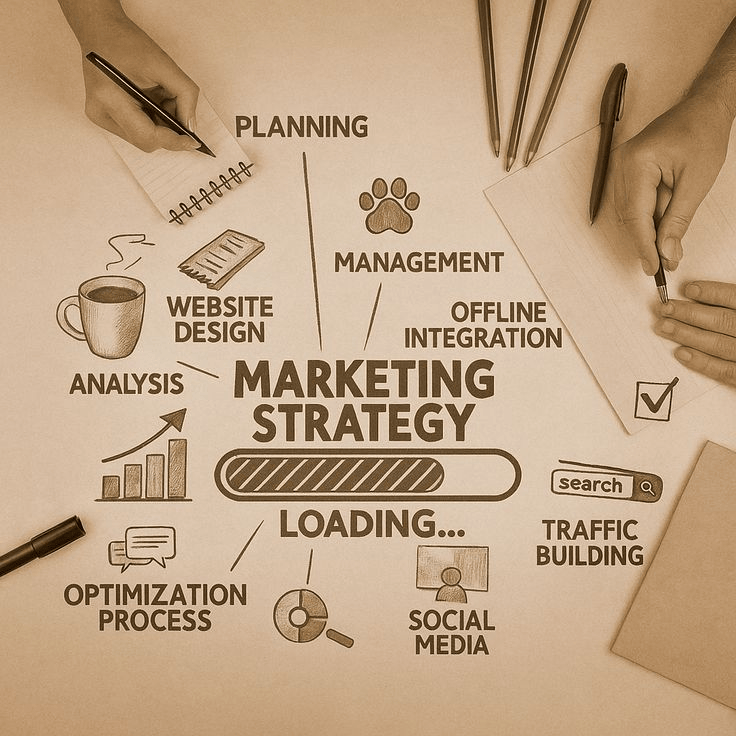
Running a small business already gives you plenty to think about. There are customers to serve, bills to manage, products to improve, employees to support, and new opportunities to chase.
Then marketing enters the picture.
You hear that you need SEO. Someone tells you to run Google Ads. Another person says Instagram is the answer. Your inbox is full of email marketing advice, while every other video online seems to recommend a completely different growth tactic.
It is easy to feel as though you need to do everything at once.
You do not.
A strong digital marketing strategy for a small business is not about being everywhere. It is about understanding what you want to achieve, knowing who you want to reach, and choosing the few channels most likely to connect those two things.
This guide will show you how to build that strategy step by step without turning your marketing into a complicated collection of disconnected activities.
A digital marketing strategy is a clear plan for using online channels to achieve specific business goals.
Those channels can include search engines, your website, social media, paid advertising, email, content, and other digital platforms.
The important word is strategy.
Posting on social media is an activity.
Running an advertisement is an activity.
Publishing a blog is an activity.
Sending an email is an activity.
A strategy explains why you are doing those things, who they are meant to reach, what action you want people to take, and how you will know whether they are working.
Without that connection, businesses can stay busy with marketing without making meaningful progress.
Small businesses usually have limited time, limited staff, and limited marketing budgets. That makes focus especially important.
Trying every available digital marketing channel can spread your resources too thin.
A better approach is to identify your strongest opportunities first, build a solid foundation, measure what happens, and expand when the results justify it. Current small business marketing guidance similarly emphasizes starting with a focused selection of channels and building from there rather than trying to master everything immediately.
Think of your strategy as a filter.
Every new marketing idea should have to answer a simple question.
Does this help us achieve one of our current business goals?
If the answer is no, it probably does not deserve your attention right now.
One of the most common marketing mistakes is starting with a channel.
A business owner might say:
“We need to post more on Instagram.”
Or:
“We should start doing SEO.”
Or:
“Maybe we need Google Ads.”
But none of those statements explains what the business actually needs.
Start with the result.
Perhaps you want to:
Once the business goal is clear, you can decide which digital marketing channels make sense.
For example, a local home service company looking for more calls may prioritize local search visibility and paid search.
An ecommerce brand trying to increase repeat orders may focus more heavily on email marketing, remarketing, and customer retention.
A new business that people have never heard of may need awareness content before expecting immediate sales.
The channel should follow the goal, not the other way around.
Marketing becomes much easier when you know exactly who you are speaking to.
You do not need a twenty page customer profile. You need useful answers to practical questions.
Who normally buys from you?
What problem brings them to your business?
What questions do they ask before buying?
What worries might stop them from making a decision?
Where do they look for information?
What matters most when comparing different options?
Price?
Speed?
Trust?
Experience?
Convenience?
Quality?
Support?
The answers will shape your messaging.
Imagine two businesses selling the same software.
One targets small business owners who want something simple and affordable.
The other targets established companies that care about advanced integrations, security, and scalability.
The product category may be similar, but the marketing should sound completely different.
When your audience feels that your content understands their situation, your message becomes much more relevant.
Before building something new, look at what you already have.
Open your website as if you had never seen the business before.
Can you understand what the company does within a few seconds?
Is it obvious who the business helps?
Can visitors find important information easily?
Is there a clear next action?
Does the website work comfortably on a phone?
Are contact forms easy to complete?
Are your social profiles current?
Does your business information match across different platforms?
Which pages currently receive traffic?
Which marketing channels already generate enquiries or sales?
This simple review can prevent wasted spending.
There is little value in paying for more website traffic if visitors arrive and cannot understand what you offer.
Sometimes the fastest marketing improvement comes from fixing the experience you already have rather than adding another channel.
Not everyone visiting your website is ready to buy immediately.
Some people are discovering a problem.
Some are researching possible solutions.
Others are comparing businesses.
A smaller group may be ready to contact you or make a purchase right now.
Your digital marketing strategy should provide useful information at different stages of that journey.
The person is learning about a problem.
Useful content might include:
Guides
Educational articles
Simple explanations
Checklists
Videos
Common mistakes
Frequently asked questions
The person understands the problem and is exploring possible solutions.
Useful content can include:
Comparison guides
Case studies
Detailed explanations
Buying considerations
Examples
Product demonstrations
The person is closer to taking action.
Useful pages can include:
Service pages
Product pages
Pricing information
Testimonials
Contact pages
Consultation pages
Booking forms
This distinction also helps protect your SEO strategy from keyword cannibalization.
An informational blog should answer questions.
A commercial service page should explain a solution you sell.
Keeping those purposes separate gives every important page a clearer role.
You do not need every channel.
You need the right combination for your audience, goals, budget, and buying cycle.
Search engine optimization helps your website become easier to discover when people search for information related to your business.
SEO can be especially useful when customers already use search engines to research problems, compare options, or find providers.
A strong SEO strategy normally involves several areas.
Technical website health
Keyword research
Search intent
Useful content
Page optimization
Internal linking
Website authority
Local visibility where relevant
The goal should not simply be attracting more visitors.
The real goal is attracting people who are relevant to your business.
A thousand uninterested visitors may be less valuable than fifty people actively researching the problem you solve.
Content gives your business something useful to say before asking people to buy.
Good content can answer questions, explain complicated subjects, help customers make decisions, and support visibility in search.
Your content marketing strategy might include:
Avoid publishing articles simply because a keyword has traffic.
Every piece should serve a clear purpose.
Ask:
Who is this for?
What question does it answer?
What search intent does it target?
Which page should readers visit next?
That is how individual articles become part of a larger strategy instead of becoming isolated blog posts.
Pay per click advertising can help a business appear in front of potential customers more quickly.
It can be useful when you have a clear offer, know what a customer is worth, and have a landing page capable of turning interest into action.
Do not judge advertising only by clicks.
Look further.
How many visitors became leads?
How many leads became customers?
Which keywords produced valuable enquiries?
Which campaigns produced revenue?
Which audiences spent money without producing meaningful results?
Marketing becomes much easier to improve when decisions are based on outcomes instead of surface level activity.
Social media works best when there is a reason for people to pay attention.
Posting simply because the calendar says it is Tuesday rarely creates a memorable brand.
Think about what your audience would genuinely find useful, interesting, entertaining, or worth sharing.
Depending on your business, that could mean:
Educational advice
Short demonstrations
Customer results
Behind the scenes content
Industry observations
Frequently asked questions
Product demonstrations
Useful tips
Stories from your team
You also do not need to be active on every platform.
A business selling visually interesting consumer products may naturally have different priorities from a business selling specialist software to corporate decision makers.
Choose channels based on audience behavior, not popularity.
Email gives you a way to continue the conversation with people who have already shown an interest in your business.
That can include potential customers, existing customers, subscribers, previous buyers, or people who requested information.
Useful email campaigns might include:
Welcome messages
Educational sequences
New content
Helpful tips
Product updates
Abandoned purchase reminders
Customer follow ups
Special announcements
Reactivation campaigns
The important thing is relevance.
Sending more emails is not automatically better marketing.
Sending the right message to the right person at the right stage is far more useful.
Your website connects many of these channels.
Someone may discover you through Google, click an advertisement, see a social post, receive an email, and eventually visit your site before deciding what to do.
That means your website needs to answer basic questions clearly.
What do you offer?
Who is it for?
Why should the visitor trust you?
What should they do next?
A website should not make people work to understand the business.
Clear communication usually beats clever language.
Once you have chosen your main channels, create a realistic publishing schedule.
Do not begin by promising yourself five blog articles, fourteen social posts, three videos, and a newsletter every week.
You are building a system that needs to survive beyond the first month.
A small business might begin with something as simple as:
Two useful blog articles each month
Three social posts each week
One email newsletter each month
One customer story each month
One important website improvement each month
The exact numbers are less important than consistency and quality.
Create content around real customer questions whenever possible.
Sales calls, support messages, emails, reviews, and conversations with customers can all reveal topics worth covering.
If customers repeatedly ask a question, there is a good chance other potential customers are searching for the same answer.
A marketing budget should reflect both your goals and the stage of your business.
Do not simply divide money equally between every channel.
Consider what each part of your marketing is expected to achieve.
Your budget may need to cover things such as:
Website improvements
Content production
SEO tools
Paid advertising
Design
Email software
Analytics
Video production
Marketing support
Instead of asking, “How much should we spend on marketing?” start asking, “What result are we trying to create with this money?”
That changes budgeting from an expense discussion into a performance discussion.
Marketing reports can contain hundreds of numbers.
Most businesses do not need hundreds of numbers.
They need a small set that helps them make better decisions.
Depending on your goal, useful marketing KPIs could include:
Website enquiries
Qualified leads
Online sales
Conversion rate
Organic search traffic
Important keyword visibility
Cost per lead
Cost per customer
Revenue from advertising
Email signups
Repeat purchases
Booked calls
Do not become distracted by numbers that look impressive but do not connect to business results.
More impressions may be useful.
More followers may be useful.
More website traffic may be useful.
But the question remains:
Did those numbers help move the business toward its goal?
A digital marketing plan should not be written once and ignored for the rest of the year.
Review performance regularly.
Look for patterns.
Which content attracts relevant visitors?
Which search terms bring potential customers?
Which advertisements generate qualified leads?
Where do website visitors leave?
Which emails receive responses?
Which channels consume time without producing useful results?
Then adjust.
You might increase investment in a channel that is performing well.
You might rewrite a weak landing page.
You might stop producing content for a platform your customers rarely use.
You might discover a new question that deserves an article.
Good digital marketing is not built on knowing everything in advance.
It is built on learning from what happens.
More channels create more work.
Being consistently useful in two places is usually better than being barely present in seven.
A keyword alone does not tell you what someone wants.
Look at the question behind the search.
Someone searching “what is SEO” wants education.
Someone searching for an SEO provider has a different purpose.
Those searches should not necessarily lead to the same type of page.
Your homepage cannot answer every question.
Use specific pages that match the visitor’s intention.
Growth does not always require finding strangers.
Past customers already know your business.
Retention, repeat purchases, referrals, and email communication deserve a place in your strategy.
Traffic is useful only when it supports a larger goal.
Track what happens after people arrive.
Competitor research can reveal opportunities, but copying another company’s marketing removes the thing that makes your business different.
Understand what others are doing, then decide what makes sense for your own audience.
You do not need to redesign your entire marketing operation tomorrow.
Here is a practical way to begin.
Define your main business goal.
Identify your ideal customer.
Audit your website.
Review your existing traffic and leads.
Choose your primary marketing channels.
Research the questions your audience is asking.
Set up essential performance tracking.
Publish useful informational content.
Improve important website pages.
Begin consistent social content where relevant.
Launch a small paid campaign if it fits your strategy.
Build or clean your email list.
Create clear calls to action.
Review which channels produced useful activity.
Identify your strongest content.
Study lead quality.
Improve pages that receive traffic but few enquiries.
Reduce spending on weak campaigns.
Increase effort where results are strongest.
Plan the next three months using what you learned.
That is a much healthier approach than changing strategies every week.
There is no single strategy that works for every small business. The right approach depends on your audience, goals, location, budget, industry, and customer buying journey. Start by identifying the result you need, then choose the channels most capable of producing it.
Start with a clear business goal, define your target audience, audit your existing online presence, map the customer journey, select a small number of relevant marketing channels, create a realistic content plan, set a budget, and track meaningful results.
Begin where your customers are most likely to look for a solution. Search may be important for businesses with existing customer demand. Social media may be useful for visual or community focused brands. Email can be valuable when you already have an audience or customer base.
SEO can be valuable when potential customers use search engines to find information, products, local businesses, or solutions related to what you offer. It is most effective when the website targets relevant search intent instead of simply chasing high traffic keywords.
There is no universal budget. Spending should reflect your margins, goals, customer value, competition, current stage, and available resources. Start with an amount you can measure properly, then increase investment when a channel demonstrates value.
Performance should be monitored regularly, while larger strategic decisions should be based on enough data to identify meaningful patterns. Avoid changing direction because of one weak day or one unusually strong campaign.
Some businesses can manage parts of their marketing internally, especially when the strategy is focused. As the number of channels, campaigns, technical requirements, and reporting needs grows, specialist support can become useful.
The biggest digital marketing problem for many small businesses is not a lack of activity.
It is a lack of connection between those activities.
The website is doing one thing.
Social media is doing another.
Advertising is sending traffic somewhere else.
Blog content has no clear next step.
Email exists but rarely gets used.
A better digital marketing strategy connects these pieces around one customer journey and one set of measurable goals.
Start small.
Understand your customer.
Choose your channels carefully.
Create content that answers real questions.
Track what produces meaningful business results.
Then improve what works.
Optimistx Tech Lab works across SEO, web design and development, pay per click advertising, content marketing, social media, analytics, and related digital growth areas, which makes this type of connected strategy directly relevant to the wider expertise already represented across the website.
The goal is not to do more marketing.
The goal is to make every part of your marketing work together.